AI does not have to be deterministic to give reliable results
If you have ever asked an AI the same question twice and gotten two different answers, you already know why some people will not trust it with real work. I heard the strongest version of that argument at the KC AI Expo on Tuesday. It came from a consultant who builds and rolls out Salesforce for companies and is bearish on AI. He took issue when I said that AI agents can produce deterministic results inside the right governance framework.
He is right about the model
An AI model is probabilistic. The same prompt can give different answers, and no setting changes that completely. If deterministic means the same input always gives the same output, the model is not deterministic, and I told him so.
What changed my thinking in the moment is that the model is not the system. A business does not run on one answer from one model. It runs on whether the whole system gives a reliable result that is acceptable to the people who depend on it.
The rules around the model do not vary
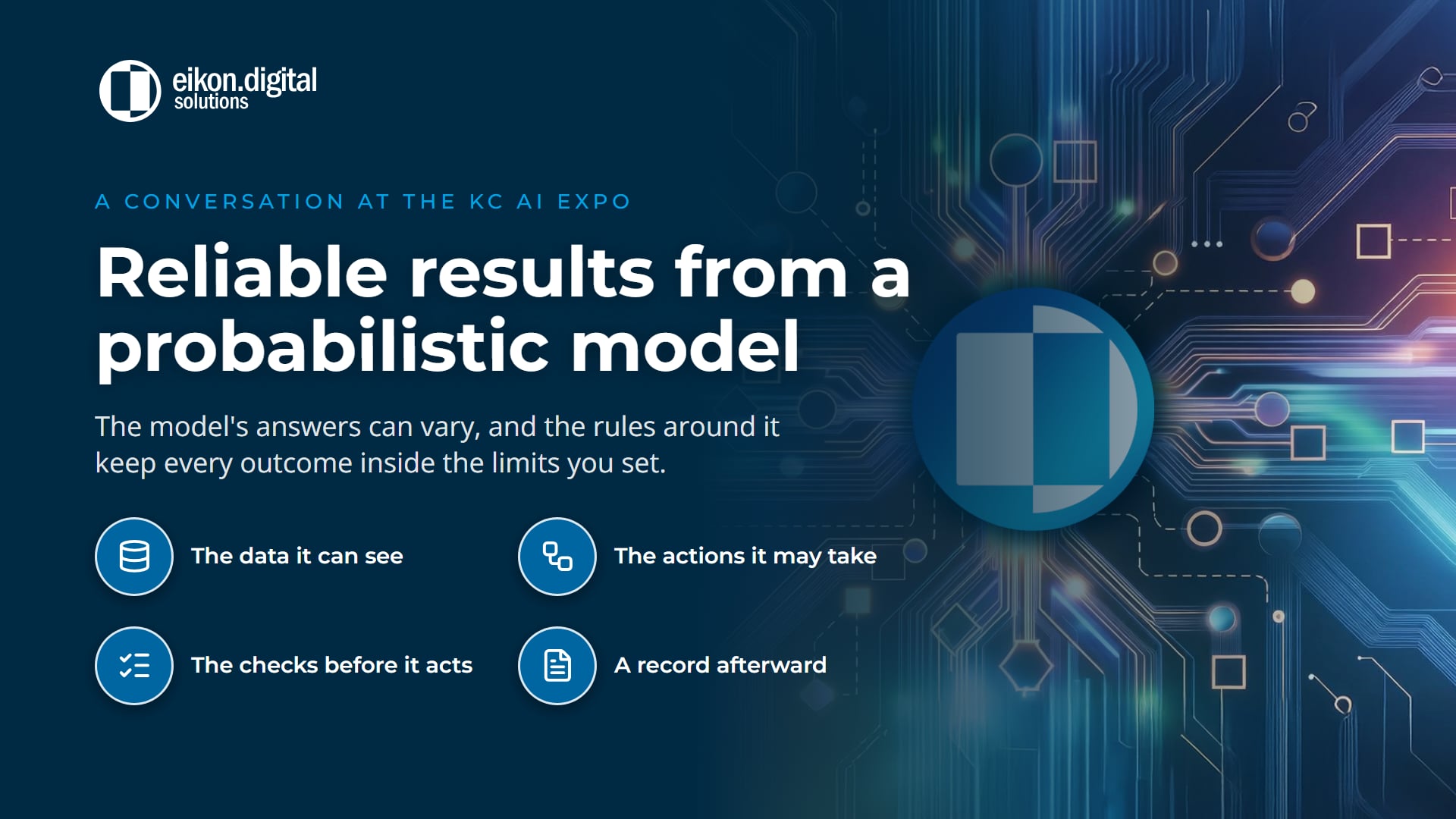
The model drafts an answer. The system around it decides what data the model can see, which actions it is allowed to take, what checks run before anything happens, and what record is kept afterward. Those rules are the same on every run.
The wording of an answer can change from one run to the next. The limits on what the AI can do with that answer do not change.
Software has always worked this way
I have never met two developers who code exactly alike. If you compare one developer's work week over week, the solutions vary too, and some of that variation is small errors. Work still gets done and business still happens, because specifications, reviews, and approvals keep the outcome reliable even when the process varies.
AI can work the same way. The generation step can vary while the boundaries of its authority and the checks on its output stay fixed.
What I would and would not hand to AI
There are things I would never give AI. There is a lot I would, when it is governed well and has access to the right information.
We do not need AI to be deterministic. We need the limits on what it can do to be fixed, and what it produces to be checkable.
What I am claiming
I am making three claims. AI agents that act without controls do things their owners did not expect. The model will always vary, so the controls have to live outside it. And an agent that works inside strong controls can be trusted with more of the work.
I can prove it. Read the next article in the three-part series.
Get the next article in your inbox.
I write about using AI in a business without losing control of it. Join the list and I will send new articles when they are published. Unsubscribe any time.
Latest articles
 Why your AI keeps writing blog posts that could be about anyone
 Why a five-person company can run Netflix's architecture for $30 a month
 Your CRM has 800 contacts. You actively talk to 40.
 You know what your best customer looks like. You just don't have time to find the next dozen.
 Friday 7:47 PM. You paid for that lead twice and you don't even know it happened.
